
WE HADN’T RAISED ALFALFA ON OUR FARM FOR NEARLY 30 YEARS!
When I was heading back for my senior year of college, one of my last jobs for the summer was to haul the remaining livestock to town. Dad was getting out of the livestock business as he was losing his “cheap” labor. Summers of baling hay were over on the Hefty farm.
Fast-forward to the 2020s, when the expansion of a neighboring dairy farm gave us the opportunity to add alfalfa back into our crop rotation. After working with so many farmers on alfalfa management plans for their farms and learning tips and tricks from many of them, we were excited to see what we could do with alfalfa on our own ground.
BELOW ARE THE PRACTICES THAT HAVE MADE AN IMPACT FOR US AND FOR OTHERS.
1. PRE-PLANT INCORPORATED HERBICIDE
You’ve likely heard us talk about this before, but using 4.5 pints/acre of Eptam before seeding the alfalfa is the real deal. Our fields stayed pretty clean for four years, allowing us to maximize tonnage.
2. FERTILITY
Loading up the soil in advance with the non-leachable soil nutrients (P & K especially) was a game changer! The feed value of the hay was fantastic, and the tonnage produced made alfalfa our most profitable crop in years two and three of the stand compared to anything else we were raising. Our advice is to start planning where you will seed alfalfa three years in advance so you can build soil pH to 6.8 or above and so you can spread your build rates of P & K over three years instead of putting all that expense into one year.
3. BETWEEN CUTTINGS
I’ll expound on this one in the column to the right as there’s quite a bit to cover in the middle of the season.
4. END OF SEASON
We’ve had good luck with winter survival and early-season vigor using a strobilurin fungicide on the last application of
the season. Something like 3 ounces per acre of Quadris or 1 ounce per acre of Evito would be inexpensive and effective.
HERE ARE THE TREATMENTS WE’VE HAD THE MOST SUCCESS WITH BETWEEN OUR FOUR ALFALFA CUTTINGS IN-SEASON.
1. NUTRITION
We use a blend of micronutrients between each cutting. It’s typically been a blend of 1 quart per acre of something like Micro 500 (for micronutrients) plus FulFour at 6 ounces per acre (a fulvic acid).
2. FULVIC ACID
Speaking of fulvic acid, we’ve had so much success using it with our nutrient applications because it seems to help the fertility get into the plant and move it where it needs to be within the plant. With fulvic, we’ve seen better yield and/or tonnage in a variety of crops. We’ve used both FulFour and Nutex EDA, as they contain both fulvic and fertility..
3. PLANT GROWITH HORMONES
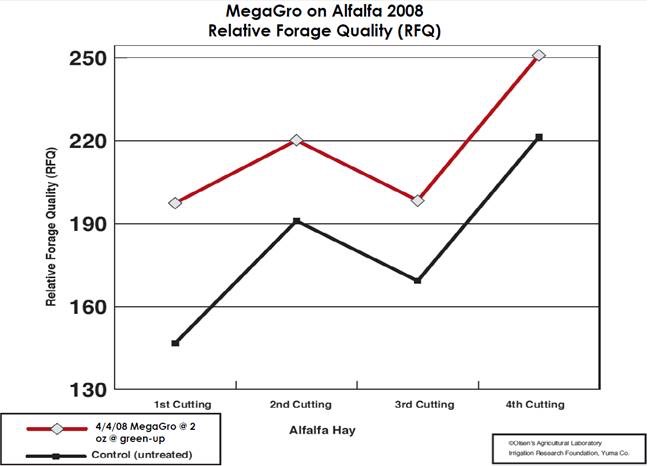
We really like MegaGro at 2 ounces per acre in each of these applications. It’s hard to say we’ve seen a tonnage change due to MegaGro because we haven’t tested it solo. However, we’ve seen better RFQ (relative forage quality) values with it in the tank. Since MegaGro has been out for 20 years, there’s data on just about everything. On the next page is a study done back in 2008 illustrating what I’m talking about with RFQ improvement.
4. AMINO ACIDS
Protein is where it’s at for alfalfa, and the building blocks
of proteins are amino acids. There are lots of amino acid
products out there, but the ones we’ve had the best success
with have been plant-based. We use Boost 10 at 10 ounces
per acre.
5. INSECTICIDE
It’s important to scout before spraying in alfalfa for many reasons; but since insects can attack the crop at any point through the season, they are definitely something to watch out for. If you see problem insects, Mustang Maxx is inexpensive and has a three-day pre-harvest interval. If you need a different mode of action for alfalfa weevil larvae or other bugs, Steward only has a seven-day pre-harvest
interval, and chlorpyrifos and others are labeled, as well.
WHAT ARE WE EXPERIMENTING WITH THIS YEAR?
If you’ve followed us for more than a minute, you know we are always trying new things. During the Neal Kinsey seminar we hosted this winter, sulfur was talked about for alfalfa and how it has helped production for others. We plan to try spreading dry AMS at 100 pounds per acre both earlyin the spring and in between each cutting to see if it pays. As an alternative, we’re also going to try AgroLiquid’s accesS (a liquid sulfur product) to our normal between-cuttings foliar application to see if that’s better or worse than dry AMS. With the accesS, we would save a trip; but with the dry AMS, it would be more of a slow release. We’ll see how each treatment works and let you know what we find.