

NO MATTER THE CROP, ITS NUMBER ONE JOB IS TO REPRODUCE.
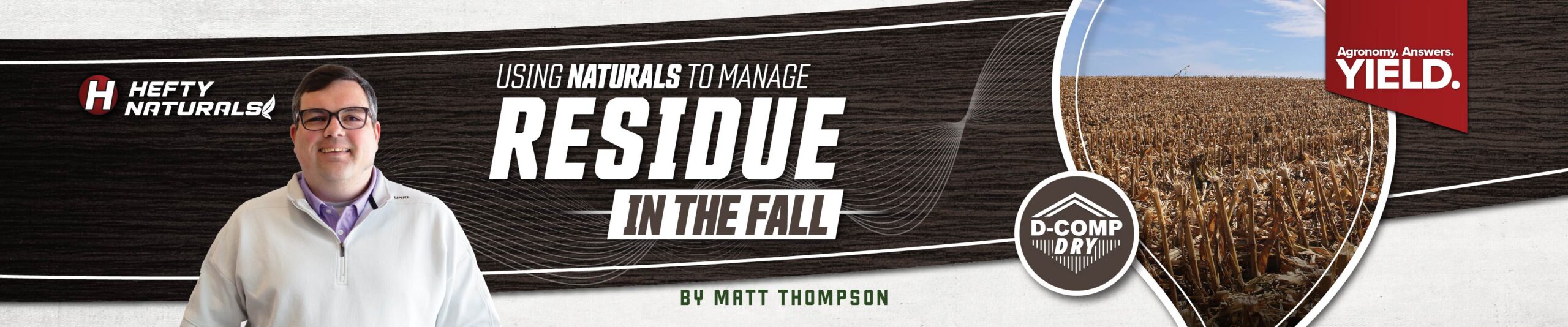
And as we’ve continued to push our yield limits over the last 20 years, we have seen a significant increase in residue generated from the crops we harvest. For every bushel a corn plant generates, about half of that weight is also accumulated in plant mass. Various crop management strategies can further increase plant residues.
For example, planting longer day maturities and spraying fungicide once or even twice during reproductive timings all lead to additional green plant mass.
Here’s another way to think about it.
A 200-bushel corn crop can create more than 4.5 tons of crop residue!
That means that roughly each 40-bushel yield increase is equivalent to nearly a ton of additional residue that must be managed. As residues increase, so does the potential for problems with planting, germination, and stand establishment. Where do biological products fit as a tool to break residue down?
Before we dive into any specific products, let’s review the composition of crop residue.

THIS MATERIAL MAKES UP MUCH OF THE OVERALL STRUCTURE OF PLANT CELLS. It’s not a carbohydrate, so it’s nearly impossible to break down. Lignin is the glue that holds the plant structure together. It strengthens the vascular system, waterproofs the xylem, and protects the cellulose and hemicellulose from breaking down. Since it essentially provides strength and reinforcement to cell walls, lignin is also the plant’s natural defense against pathogens and microbial attacks.

THESE ARE THE LONG FIBERS THAT HOLD THE PLANT TOGETHER. Ultimately, cellulose is the rebar of the plant cells and is what gives the plant rigidity. Critically, just as one of the roles of lignin is to protect cellulose, the fibrous rebar of cellulose protects hemicellulose.

THIS TISSUE IS WHERE PLANT-AVAILABLE NUTRIENTS AND PLANT ENERGY GET TIED UP. Since it is made up of simple sugar structure, it is the simplest for microbial products to break down. The overall goal is to access and break down the hemicellulose, but in order to do so, you have to break down both lignin and cellulose.
When it comes to crop residue breakdown, lignin is our greatest enemy. If we can’t break down lignin, we can’t cycle critical plant nutrients back into the soil in a timely fashion.

Only a few things will naturally break lignin down, the most popular being fungi. One product we have used to achieve this since 2019 is D-COMP. In 2024, this product was converted from a liquid to a dry product, which opened the doors for us to include additional mechanisms for residual breakdown.
Here are some examples.
- 1
FUNGI: One of the strongest tools for breaking down lignin is the white rot fungi, Phanerochaete chrysosporium. It does this by releasing multiple enzymes that break lignin down into smaller pieces that are more easily attacked by bacteria. The three most common enzymes that are used to break down lignin are laccase, manganese peroxidase, and lignin peroxidase. These three enzymes act as chain saws, scalpels, and bullets to break the bonds that hold lignin together. Simply put, without these enzymes, lignin can’t be broken down. By using fungi to release enzymes, you create a breakdown factory that doesn’t stop.
- 2
ENZYMES: In the last section, I talked about enzymes needed to break lignin down, but you also need enzymes to break down cellulose and hemicellulose. What we have learned through years of product testing is that adding enzymes alone to residue is great to jump start the breakdown of plant material, but once they’ve done their job, you no longer have any enzyme left. That’s why when we add enzymes to applications we also include the parent that makes the enzymes, so we have a factory continually creating enzymes to help continue breakdown. Some key enzymes used to break down cellulose and hemicellulose are cellulase, xylanase, amylase, and pectinase. Once these are introduced, bacteria strains are more able to finish the job of cycling nutrients for the next crop.
- 3
BACTERIA: These become an avenue to create some of the enzymes needed to break cellulose and hemicellulose down. They are also needed to cycle nutrients from residue back into the soil. Think of bacteria as a factory creating enzymes, but they also use what the enzymes break down to cycle nutrients back into the soil.
DRY D-COMP CONTAINS ALL THESE TOOLS AND IS ONE OF THE ONLY PRODUCTS IN THE MARKET IN THE RESIDUE BREAKDOWN CATEGORY TO DO SO.
This product is the complete package needed for residue management with biologicals, and this combination of components ultimately represents speed.
Other companies in the market will make the claim biological products in this space will, one – save you a tillage pass; and two – allow you to reduce nutrient spend in the fall because you are releasing them from crop residue. I struggle to agree with these assertions. We have yet to see results sufficient to justify saving a tillage pass. Also, while it is true that you can speed up the release of nutrients from crop residue, it isn’t enough for me to say you can stop applying a certain amount of fertility.
Here’s where biological products are important.
They are a tool. They can make a tillage pass easier. They can help shrink the residue for spring planting. They help manage potential disease pressure by limiting the amount of residue that overwinters. However, they do NOT replace a tillage pass, nor will they save you significant costs by lowering your fertility bill.
WE RECOMMEND THESE PRODUCTS TO BE USED IN NO-TILL SITUATIONS, HIGHLY ERODIBLE LAND (HEL), MINIMUM TILL, AND IN CORN-ON-CORN ACRES.
The best timing for these products is right after the combine leaves the field. Spray with 10 GPA of water, ensuring no chlorine exists in the water source. We also want to see nighttime temps above freezing and daytime temps above 50 for at least a week after application. Because Dry D-Comp has all the tools needed to break residue down, you don’t need to add any additional nitrogen, sulfur, carbon, or sugar to the mix as a food source. Finally, you can mix your fall burndown or residual products in the tank along with Dry D-Comp.
At the end of the day, think of Dry D-Comp as a tool to help manage residue. These tools can work great if you use them with correct practices and expectations.

If you have any questions about tank mix partners or application timings, reach out to your local HEFTY AGRONOMIST for more information.