IF COMMODITY PRICES DOUBLED AND YOUR HERBICIDE COSTS WERE HALF, WOULD YOU BE MORE LIKELY TO SPRAY A LATE-SEASON SOYBEAN HERBICIDE?

IN THE FALL OF 2005, CORN IN OUR LOCAL AREA BOTTOMED OUT AT $1.30 PER BUSHEL. SOYBEANS WERE UNDER $5.
Today in my area, soybeans are more than double that price and corn is more than triple. Compared to fall 2005/spring 2006, soybean herbicide costs today are roughly half of what they were back then.
My whole point here is to stress the fact that we had lots of farmers spraying soybean weeds in 2006; but today, yields and yield potential are much higher, soybean prices are more than double, and the herbicide costs are roughly half. In other words, the ROI potential is at least 4X what it was back then!
I will never tell you to apply a herbicide just because crop prices are great or the herbicide is cheap. Similarly, I will never tell you NOT to spray a herbicide because cash is tight, crop prices are low, or the herbicide is expensive. INSTEAD, WE ALWAYS TRY TO FOCUS ON RETURN ON INVESTMENT.
SO, HERE ARE SOME IMPORTANT QUESTIONS TO ASK YOURSELF TODAY.

USE A GROUP 15 PLUS A PPO EARLY POST.
Zidua and Warrant are the best Group 15’s for waterhemp and kochia, and they both came down a lot in price this year. Flexstar sprayed no later than early June (to avoid carryover to corn) is my favorite PPO because the residual for waterhemp and ragweed is so good, but we like Cadet (another PPO), as well. For example, Anthem Max is Cadet plus the active ingredient from Zidua. Perpetuo contains the active ingredients from Zidua and Resource (another PPO).

NOT IN ALL CASES.
Volatility is the big concern with dicamba. With Enlist One, we can’t recommend a high enough rate to kill every single weed, especially big weeds. If you choose to apply dicamba or 2,4-D, make sure that is only part of your post-emerge herbicide plan.

WHILE YOU WILL LIKELY SEE SOME LEAF BURN, YOU USUALLY WON’T SEE YIELD LOSS.
Instead, you should see yield gain from achieving better weed control. The product that burns the most is Cobra, but we’ve found you can safen Cobra significantly by adding 1.25 pounds of Solubor (dry, water-soluble boron) per acre, and if you luck out and get rain within a week or so after spraying, the soybeans usually look great again pretty quickly.

YES.
Obviously, the more weeds the more yield impact, so if you only have a handful of weeds it is no big deal; but if there are lots of weeds, it is possible yield could go down by 5 to 10 bushels per acre.

ABSOLUTELY!
If you have 20 waterhemp plants IN A WHOLE FIELD, you would say that field is “very clean”, right? If each plant puts out 1 million seeds and even if only half of them grow, that means you could have 10 MILLION WEEDS in that field the next year. Even if you get 99% control between your pre-emerge and your early post-emerge herbicide passes, that still leaves 100,000 weeds in the field!! I understand the old theory of, “it’s not worth it to spray when there are only a few weeds out there,” and I agree with that in terms of yield loss this year. However, I know that fighting those weeds in the future can be challenging and expensive, so sometimes it is worth it to spray even if there are just a few weeds left.

EARLY ON, DEPENDING ON THE TRAIT, USE LIBERTY (USUALLY OUR FIRST CHOICE), ENLIST ONE, ROUNDUP, OR DICAMBA BECAUSE THEY ARE FAR BETTER THAN MOST OF THE PRODUCTS BELOW.
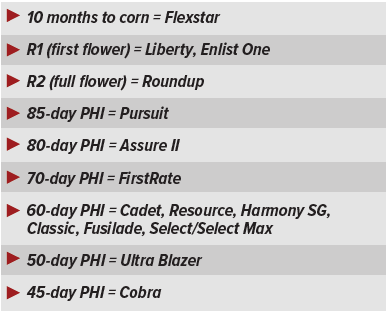
Once you see pods on your soybeans, you are at least at R3. That means Roundup, Liberty, dicamba, and Enlist One are all off the table. If you have pigweeds, ragweed, or kochia, Cobra is probably your best bet, but many people like the fact that Ultra Blazer and Cadet have less leaf burn. The ALS herbicides (Classic, Harmony SG, Pursuit, and FirstRate) have activity on a few weed species, but won’t stop anything that has ALS resistance. Plus, spraying late with Classic, Pursuit, or FirstRate could lead to carryover issues, so be careful. As far as grass and volunteer corn, products like Select Max, Assure II, and Fusilade are still excellent with little to no crop response.
BELOW ARE SOME COMMONLY USED SOYBEAN HERBICIDES LISTED IN REVERSE ORDER OF HOW LATE YOU CAN APPLY THEM. NOTE THAT PHI STANDS FOR PRE-HARVEST INTERVAL.