
LAND AND PROFITABILITY.
These are TWO BASIC FACTORS any farm must consider when planning each season, but it is especially important when determining long-term goals.
For many mid-size farms in the United States, the economic truth is that operations are frequently limited by both acres and personnel, and the relationship between these two is often a catch-22. When growth is limited by acres, it can be difficult to bring on more help; yet without sufficient profits, there may not be enough revenue to support the livelihood of multiple generations on a family farm.
Casey Schmit’s family operation has grappled with this dynamic as they’ve worked to bring the newest generation into the fold.
Casey, 32, and his brother, Ryley, 29, work with their uncle, Roger, on a 1000-acre corn and soybean operation near Gully, MN. Although they grew up on their dad’s dairy farm, they quickly found their love was for crops over cattle.
“We bottle fed calves,” Casey said. “That was our job, and we didn’t mind it, but we gravitated towards the fields.”
By the age of 13 or 14 – whenever Casey and Ryley were old enough to hop onto four-wheelers – they started helping Roger put up hay and do field operations, especially in the alfalfa fields at first. Basically, they were willing to do anything they could to get into the tractor cab.
“Once my uncle figured out that we could run tractors and be of some assistance to him in the fields, he just was, ‘Hey, come on over!’” Casey said.
Of course, Casey and his brother were active in school and sports, but their love of the outdoors extended beyond the farm, as well. Throughout their northern Minnesota summers, they would spend their time equally between the lake and the hayfields.
“We’d go fishing a lot, but if we weren’t doing that, we were in the tractor,” Casey said. “We’d rake, run the disk bine, and haul bales to bring them home.”
ALTHOUGH ROGER HAS ALWAYS HAD SOME BEEF CATTLE, HIS PRIMARY FOCUS HAS REMAINED CROP PRODUCTION. Back then, he had most of his acres in a wheat-soybean rotation, with an 80 of corn to use for the cattle. Roger is the first generation of his own operation, as he struck out on his own while his brother, Jerome, took over the dairy. There simply wasn’t room on the farm for two full-time operators.
FOR CASEY AND RYLEY, AS THEY APPROACHED GRADUATING FROM HIGH SCHOOL AND ENTERING THE WORKFORCE, A SIMILAR SCENARIO PRESENTED A PROBLEM.
“There wasn’t really room for us,” Casey said. “They were at that age where there wasn’t much room for growth – 1000 acres doesn’t need four full-time people. So, we both went on, but would help out every chance we could get on evenings and weekends.”
Ryley went to work at a gravel pit five miles from the farm, while Casey went to work doing pipeline maintenance, which allowed him to travel all over the country. He spent eight years on the road, but he always kept the farm in his heart, and he and his brother continued helping as often as they could.“I was just waiting for the right time for some room to come back,” Casey said. “I kept tabs on the place. Even when I was a couple states away, I would do the numbers, look at things, buy equipment, that sort of deal. We were just trying to get our ducks in a row and put our iron together so that we had everything we thought we needed before I left my job.”
THAT OPPORTUNITY CAME AS THE BROTHERS WORKED TO BUILD A CUSTOM APPLICATION BUSINESS THAT SERVED ACRES NEAR THEIR HOME IN GULLY.
As those acres grew and their supplemental income allowed, Casey was able to return and take a more active role with his uncle’s farm in the last couple of seasons. Along with Ryley, he has started to make more management decisions as they both transition in, and their goal is to someday carry the farm to the next generation.
“While Roger is still the lead on the farm, we’re managing things more,” Casey said. “He has given us the reins to do what we want and learn. This is our time to try to excel with it and take production to the level we want to.”
With new blood comes challenges and changes to management practices. The soils on the Schmit farm can be quite variable. While most of their ground is fairly moderate with cation exchange capacities around 15, the soil can get quite heavy, with CECs approaching 30 and even higher in peat areas nearby.
“We’re in a very changing area,” Casey said. “You go five miles in any direction, and you’re farming completely differently.”
THE FARM’S GEOGRAPHICAL LOCATION ALSO PRESENTS CHALLENGES.
Gully lies in northwestern Minnesota, not far from Red Lake and about a hundred miles south of the Canadian border. This region is often cold in the spring, and Casey wanted to be able to reduce surface erosion and the number of passes in the field while focusing more on fertility. So, he pushed for the adoption of strip-tillage.
“I was listening to Ag PhD, and my biggest thought was that they were 100 percent right – if we put fertility where the plant needs it, that’s the best thing,” Casey said. “So, I peer-pressured my brother into wanting strip-till, too.”
Eventually, they made building their own custom strip-till machine a big shop project, outfitting a 16-row bar with a Montag cart that has variable rate capabilities. Immediately, Casey noted efficiencies gained with strip-till requiring fewer passes across the field. “With fuel prices this spring, I knew we did a lot better this year versus conventional,” he said. “Our normal program was one pass with the chisel plow in the fall, then one or two cultivator passes in the spring, then running the floater over it – I know I’m ahead with what we’re doing.”
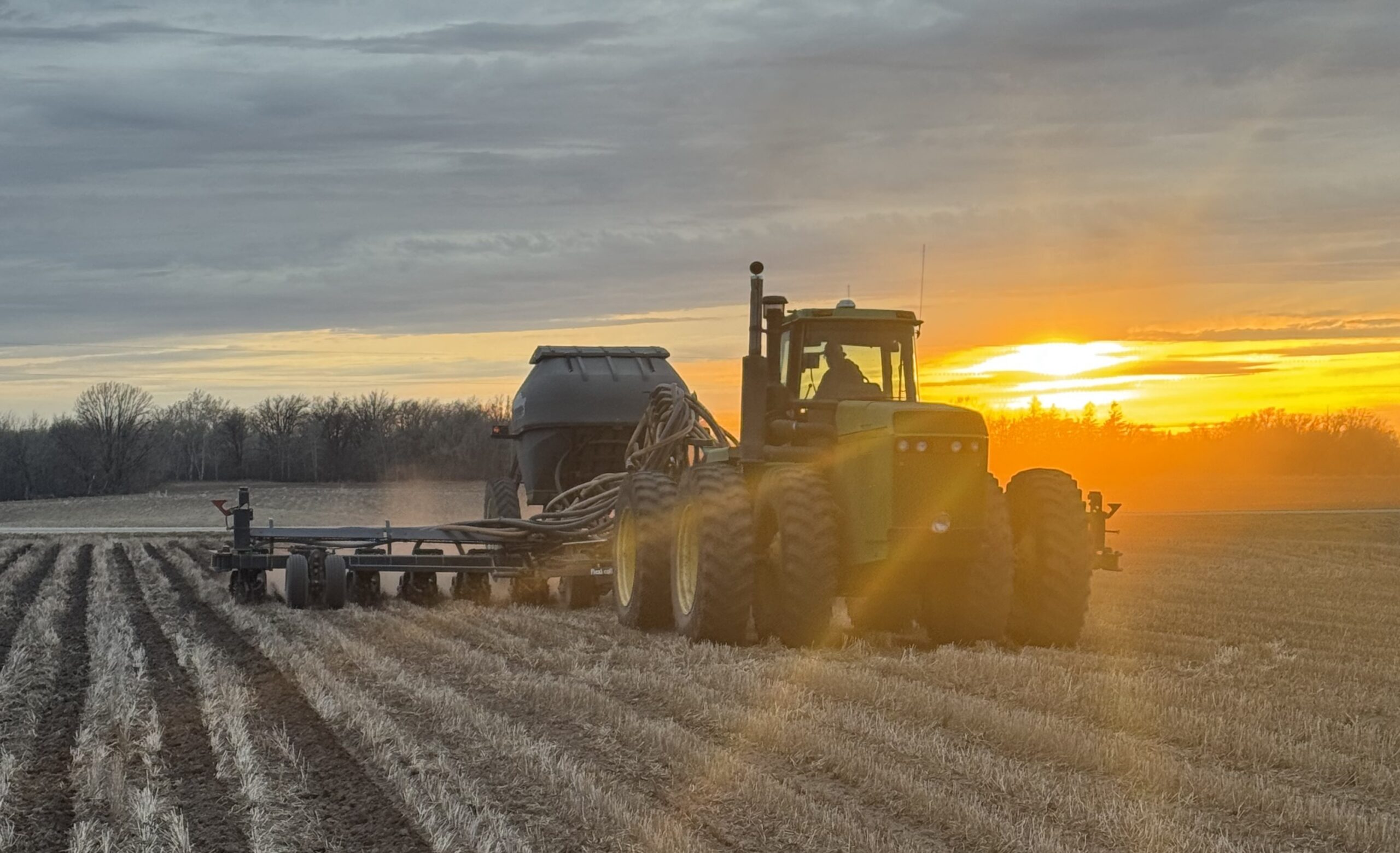
The Schmits’ custom strip-till rig has increased their efficiency in fuel consumption, as well as fertility placement.
Casey has brought a new focus to overall fertility and credits some of his attention to improving his family’s ground to listening to Ag PhD during his years on the road.
“Basically, when I was traveling the country, I was listening to Brian and Darren, and I really caught their drift on making everything count. We don’t farm a lot of acres, so we’ve got to do the absolute best we can with the acres that we are able to farm.”
WITH THAT GOAL IN MIND, THE SCHMITS HAVE STARTED GRID SAMPLING THEIR FIELDS TO LEARN MORE ABOUT THEIR VARIABILITY SO THEY CAN BE MORE COST EFFICIENT WITH INPUTS ON THE GRANULAR ACRE.
As a test, they did a field or two in one-acre sizing, but their goal is to have a three-year rotation where every field is sampled in five-acre grids. Once samples are collected, that opens the door for more intensive use of strip-till and their floater to adopt variable rate fertility management.
“We saw variability on the soil samples, and we could see it on the yield monitor,” Casey said. “So, we sat down and talked – we have this equipment that can do variable rate, so why don’t we try it? That’s what got us into VRAFY.”
THE SCHMITS HAVE HAD THEIR ACRES ON VRAFY SINCE 2024, AND THIS YEAR MARKS THEIR THIRD CROP USING THE FERTILITY MANAGEMENT PLATFORM. IN PARTICULAR, CASEY APPRECIATES LEVERAGING THE NDVI MAPS IN HIS FIELD SCOUTING.
“I try to look at the NDVI imagery before I head out scouting, as it really shows what’s going on out there,” he said. “It makes it so I’ll throw my pit bike in the back of the truck and head to the corners of the fields we usually forget about. To be able to put a visual in-person to what you see on satellite imagery is really cool.”
ANOTHER ASPECT CASEY APPRECIATES ABOUT VRAFY IS THE LEVEL OF SUPPORT PROVIDED IS FAST, ACCURATE, AND KNOWLEDGEABLE.
“If I call VRAFY early in the morning for help with grid sample points, by noon it’s in Ops Center and ready to go. In a world where you get put on hold, you don’t have that with VRAFY. You get somebody who knows what to do and they just get it done. It’s well worth the cost for what we’re doing. When I get to the end of the field and the fertilizer runs out exactly when I finish and everything is perfect – it’s just, wow. Being able to variable rate with our old machine and have it just work, that’s what gets me excited. You can’t help but smile when you get to the end of the field when it works out like it should. I have VRAFY to thank for that.”
Another resource the Schmits rely on when it comes to VRAFY and their fertility is Jesse Gagner, their local Hefty Agronomist out of the East Grand Forks, MN store. As they’ve discovered variable yields in their field, Jesse has worked to help interpret what they’re seeing in VRAFY and collect data to determine how to make adjustments.
“We have spots where we can pull big yields,” Casey said. “Now you can look at that throughout the growing season, and this year we’re taking it one step further by taking tissue samples. Jesse’s been awesome with that, and he’s helped put together our variable rate plan and find correlations that help us know how to put it all into cents.”
In addition to fertility knowledge, Casey notes that Jesse brings knowledge of both chemistry and seed to the table. As their farm pivots to raising more corn each season, the cold springs and northerly climate sometimes makes getting into the field timely a challenge.
THIS YEAR, PLANTING HEFTY BRAND 40 SERIES CORN ALLOWED THEM TO GET INTO THE FIELD EARLIER THAN EVER BEFORE.
“We were probably called crazy this year when we pulled the corn planter out before anyone else in our area,” Casey said. “That first field, we were loading the planter in our Carhartt jackets. It was cold. It took a long time to come out of the ground – more than two weeks – and that’s a little nerve-wracking. I went out to dig, and even though it wasn’t out of the ground, it was building a root system. By the time it came out of the ground, the roots were a foot deep.”
Casey also appreciates the flexibility that getting into the field early provides as the crop develops throughout the season. Even if yield stays flat, being able to spread out the work in the beginning of the season is a benefit that also extends all the way to timing and logistics at harvest time.
“The big thing for me is the earlier you plant, the drier it’s going to be in the fall, and the quicker the harvest,” he said. “We’ve combined at Christmas and in the spring. I don’t like doing it. I see it on the yield monitor where we leave off in the fall and where we pick up in the spring, and it’s horrendous what we’ve lost to the wildlife and the elements. So, if I can take it off guaranteed in the fall, I’ll put it in early in the spring.”
HOWEVER, REGARDLESS OF THE SEED PLANTED, CASEY AND RYLEY KNOW THAT THEY CAN LEAN ON THEIR AGRONOMIST TO ANSWER THEIR QUESTIONS ABOUT HOW BEST TO APPROACH THEIR MANAGEMENT STRATEGIES.
“I want to give Jesse a shout out,” Casey said. “He takes care of us through all walks of the season, and he just gets it done. When talking fertility, I sit down with him and he just gets excited about it like I do. If we need a jug of something, it’s no problem – he gets it out to us. He brings up points that I can think about that makes my life easier, and he wants us to do better and see what we can do with what we have.”
After all, for any farm, being able to do more with what you have is more important every season. When acres are limited, building up every acre makes all the difference when it comes to generating growth and success. As Casey and Ryley continue to make their mark and bring their operation forward, they’ll continue searching for the practices that increase their yield potential.
“My goal is to just put more emphasis on what we farm,” Casey said. “I just want the bushels – that’s what we strive for. Take soil health, for example. Strip-till was another big milestone we were looking for. We want to finish up sampling all our acres and start dialing everything in. After wanting this for so many years, I think we’ve got it. Now, we’re just going to keep at it and see where it leads.”