

It’s estimated that 70-80% of corn hybrids for 2027’s crop will be booked before the end of the year.
THE REAL QUESTION IS, WHAT INFORMATION WILL YOU USE TO MAKE YOUR CHOICES?
HISTORICALLY, LOOKING AT CORN HYBRID TRIALS FROM YOUR LOCAL AREA AND REGION HAS BEEN PRETTY HELPFUL. While just taking the absolute top yielder of any single plot is not normally the best way to pick a hybrid, finding hybrids that consistently place in the top third of plots and rarely finish in the bottom third is a more reliable way to qualify a hybrid based on yield.
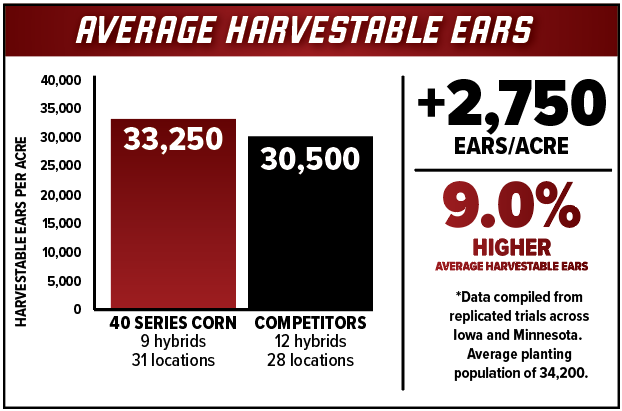
ONE OTHER THING TO NOTE IS STAND COUNTS IN PLOTS. With early planting this year, I was watching stand counts closely, especially with 40 Series Corn compared to other hybrids that didn’t meet that high standard for cold germination and early vigor. Once again, there was a significant difference. In fact, if you look at the graph on the next page, our Rockwell, Iowa location did a great job documenting an advantage of 2750 harvestable ears per acre with 40 Series corn over dozens of locations this year. That will result in an incredible yield difference!
THE ROCKWELL PLOTS WERE TAKEN FROM AREAS WITH GOOD MOISTURE FOR COMPARISON. HOWEVER, WITH MANY OF 2026’S PLOTS, I’D SUGGEST COMPLETELY THROWING OUT THE DATA.
HERE’S WHY.
I don’t know if I’ve ever noticed quite so much locally-variable weather. Sure, every year some areas get rain and others don’t. This past season, though, there was widespread extreme heat across the Corn Belt. Depending on the timeliness, speed, and quantity of rainfall received in such a hot year, what I’m noticing in plots is tremendous inconsistency.
Here are some of my top issues with plot data this year.
I. PLOTS CAN BE DECEIVING

Each hybrid hits pollination at a slightly different time even if the final maturity is similar. Two different 100-day corn hybrids could be separated in beginning pollination dates by as much as a week. If you hit pollination on the week that was nothing but sunshine and 100 degrees . . . good luck!

If all the hybrids in a corn trial were the same maturity, that would be one thing. However, most plots have a sizable spread of 5 days, 10 days, or even more. Comparing a 100-day hybrid and a 110-day hybrid is rarely a fair fight. Don’t make decisions based on one location.

We had two plots in Hillsboro, ND this year that went in one week apart from one another, even though they were only about 30 feet away. The same exact hybrid from the same bag of seed looked completely different due to the stress the first-planted crop endured the first week after emergence.

We sure saw this in 2024 and 2025 with Southern rust, but when one plot gets hit by a disease and fungicides are not used to even the playing field, there can be massive yield differences. If you don’t ever plan to use a fungicide on your farm, then this data could be useful. If you are willing to treat a field when disease is likely to occur, then you should throw this kind of untreated data out when making your decision.

This is the biggest thing to be aware of with 2026 data. On June 1st, the United States had more area impacted by drought than on any previous June 1st in history.
II. DROUGHT CONDITIONS
I love visiting hybrid trials, and we plant hybrid plots in many locations across five states. I also visit with corn and soybean breeders and look at their plots primarily in this same region. As the data is coming in, many of these plots didn’t turn out at all. Drought completely zeroed out areas of fields, and in other areas it severely limited yield. For example, if you’re in a 200-bushel corn area, what good does it do to look at a plot where the top yielder went 70 bushels?
It’s for these reasons and more that plot data cannot be totally trusted, yet may still be fine to look at from areas where rainfall and weather allowed for an average or better-yielding result.